

Our Story
Ndoto's Orgins
God began a new work in 2003 in a neglected corner of Kisumu, the third-largest city in Kenya. He called Allison Schlack to live among the people in Obunga, a slum that had never attracted the kind of charitable projects that other communities do. When planting a church didn’t succeed, God led us to start Ndoto in 2009 to address the community in a new way, starting with the next generation: education, discipleship, and development.
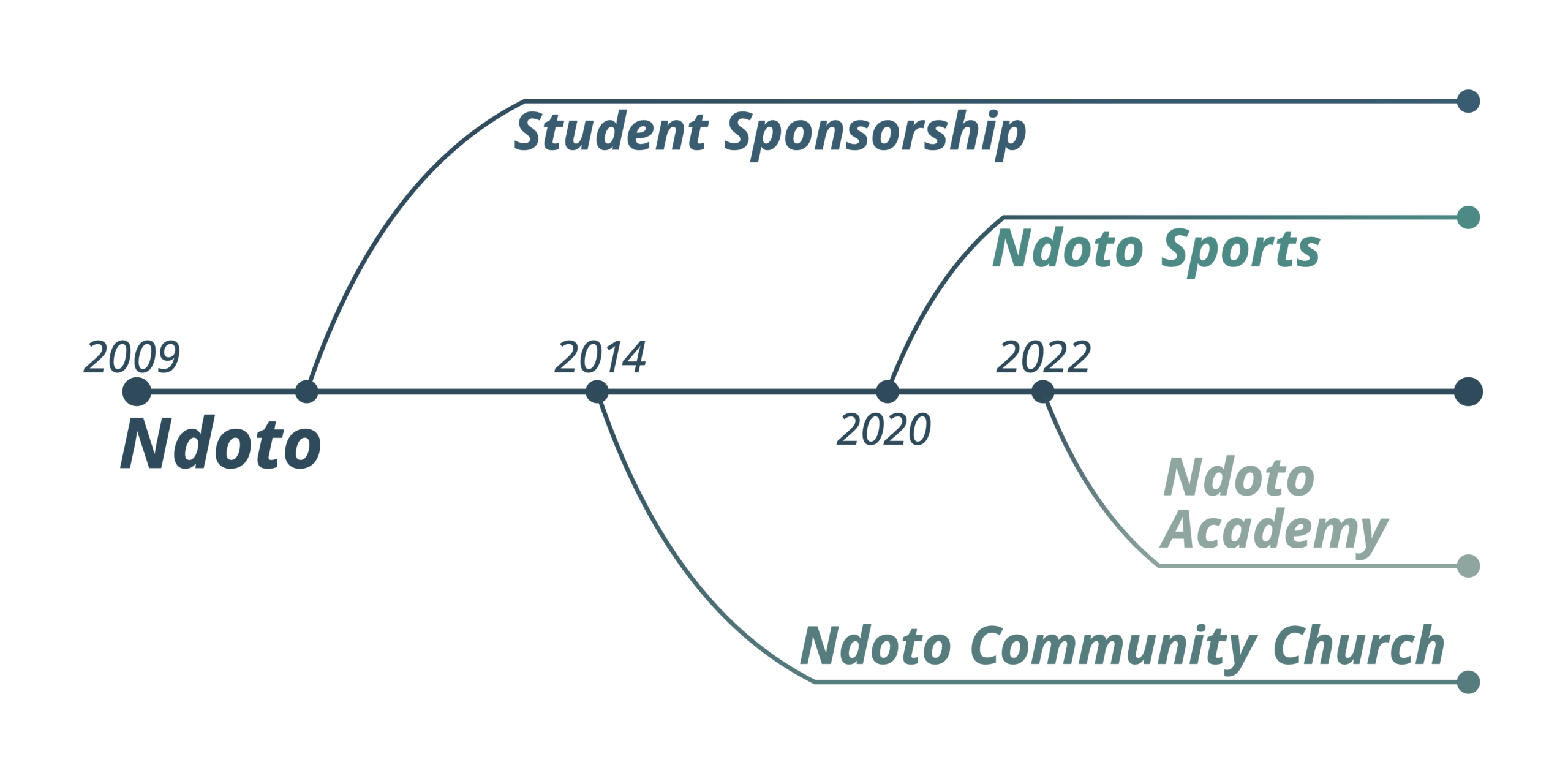
The sponsorship program came first, and God built it from 29 students in 2009 to 300 in 2021. Ndoto Community Church came next, as a faith community naturally began to grow out of the students and families in 2014. Now, God is opening doors for economic and community development. Read on to see the story of what God has done in these years.

"Ndoto" means "dream" in Swahili.
Chapter One: Allison Schlack – Following God’s Direction
Allison Schlack, a Baylor Business School student, had a difficult decision to make when she graduated in 2002. She had three choices: a lucrative job offer, a Christian camp internship, or the opportunity to go by herself to live in a slum in Kenya. Having traveled abroad, been a part of a local homeless ministry, and been mentored by pastors and community developers, she had a heart for the poor and those marginalized by society. Allison decided to take a chance on one last chance to do what she had long dreamed of.
From her experience, she knew that if she wanted to serve those in the forgotten corners of the world, she must live among them, earn their trust, and try to see things from their perspective. Her commitment to this inside out approach set her apart even from many others with a heart for the poor. She decided to see what could happen if she tried.
When the organizations she contacted refused to send a young single girl to Africa alone, Allison was referred to a Baylor student from Kenya who connected her with a young Kenyan pastor and his family. At the age of twenty-two with no agency backing and having exchanged only one email with the pastor, she boarded a plane alone with a 4x6 picture of the man who was going to pick her up at the airport. When she arrived at the Nairobi airport, no one was there. She waited. Almost an hour later, from behind the crowd, a piece of paper with her name printed on it appeared, and she spotted the man in the picture.
As she walked into the pastor’s house, she saw no running water but many mosquitoes. In her second week there, when the neighbor’s baby died of malaria, she realized that she was far from home. The suffering, death, and poverty she had so often read about were now a part of her reality.
After three months living in Kenya, she returned home devastated. Unsure of what to do next and how to reconcile her two worlds, Allison got a job with Baylor. She loved her job but something was always tugging her back to Africa. After eighteen months, she quit her job and moved back to Kenya.
The next couple of years for Allison consisted of traveling between continents, helping plant a church and creating a local ministry in Kenya, working several jobs in Dallas, and receiving her Master’s Degree from Dallas Theological Seminary in Cross-Cultural Ministries. Those years were also stranger than fiction at times. She dealt with betrayal, private investigation, theft, witchcraft, hostile takeovers, public protests, and the deaths of many loved ones. After all that, she questioned her calling to Kenya and was ready to give up. However, six months later, after some time and healing, God made it clear to Allison that He was going to redeem the situation for His glory.
With a few friends in the fall of 2009, Ndoto: For Africa’s Future was formed to empower people in the slum area where she had lived to pursue their dreams without stripping them of their dignity and survival skills. While we would today never advise anyone to do what Allison did, God turned her boldness into the potential for something big. The years of relationship-building and groundswell of community support became the foundation upon which to launch a fledgling new ministry.
“Ndoto” means “dream” in Kiswahili. This name was born out of the answers Allison would get when she asked young people about their futures. Most of the young people Allison talked to said they had dreams but had given up because there was no way they could come true. Because of the harsh circumstances in which they lived, these young people feared nothing would change and they would die with dreams unmet. Allison was emboldened by these young people to focus Ndoto on the next generation.
Allison has lived full-time in Kenya since 2011. She has always lived close to the community in which we work rather than in safer parts of town. Over the years, she began to develop a deeper relationship with Ndoto’s community pastor, who had been one of Ndoto’s first college graduates. Michael Omondi had become both Ndoto’s pastor and the Director of Ndoto Kenya. His character and wisdom had set him apart from the beginning. They were married in April 2018 and in 2019 welcomed their firstborn, a daughter named Michaela. A son, Judah, followed in 2021, and they completed their family in 2023 with Jeremiah Jace.
Michael received a visa to visit the United States for the first time in 2019, the first Kenyan that Ndoto had welcomed to the States. In 2025 he received a residency permit and the family of five moved to Dallas to continue their ministry from there.
Chapter Two: Ndoto - From Humble Beginnings
Allison Schlack’s ministry in the Obunga slum of Kisumu, Kenya, began as a personal outreach. A local pastor was leading a small church in the community and she joined him. In 2005, the ministry gained a new partner in Prince of Peace Lutheran Church in Carrollton, Texas. Prince of Peace helped to construct a strong and large church building in Obunga, which was dedicated in 2006.
Following some challenges with the ministry in Kenya, the partnership between Allison, the local pastor, and Prince of Peace dissolved in 2008. Yet, in early 2009, with most of the prior Kenyan leadership out of the picture, some of the youth who had been involved in the church asked Allison to come back. They insisted that there was a future for a ministry focused on the young people’s futures.
On September 23, 2009, a small team incorporated a new Texas nonprofit called For Africa’s Future. They rapidly renamed themselves Ndoto after an inspiration for a theme oriented around dreams. Allison served as the Executive Director, Christi Melton joined as a Sponsor Coordinator, and John Seale became the Business Manager. All three were unpaid, as were six initial Board members: Keith Montague, Colleen Hildebrandt, Roxane Malecek, Richard Cockcroft, Richard Ray, and Howard Bates. Ndoto had no paid staff members until 2011.
The first class of sponsored students, 29 young men and women ranging from college to kindergarten, began school in January 2010 with the support of 39 different sponsors. From year to year, the number of students grew rapidly: 29 became 59, then 109, then 182. In 2018, Ndoto had 296 students sponsored by 373 different households. Ndoto remained a lean organization. Including sponsorship, Ndoto’s 2010 budget was less than $50,000. In 2013, the budget surpassed $200,000, and passed $300,000 in 2016.
Education and discipleship have always been at the heart of Ndoto’s mission. In addition to paying school fees and ensuring kids were in school, Ndoto has provided discipleship opportunities through retreats since its beginning. In 2014, Ndoto graduate Michael Omondi began the Ndoto Community Church. At first it met in the lobby of the small Ndoto offices until Ndoto reclaimed the original 2006 building in 2016 and moved the church and offices there.
Economic development was also long a passion of Allison’s, and a 2006 interactive study performed by a graduate student friend in Obunga indicated that capital for business starts was high on the list of community needs. Ndoto began offering loans to promising local entrepreneurs, both Ndoto graduates and other community members. In 2018, Ndoto launched its first self-owned business, a chicken project. Hoping to generate income for the ministry by selling high-quality eggs, Ndoto built a chicken coop and hired an employee.
In the US, the ministry’s operations were growing as well. An angel investor had provided a generous unrestricted grant to the organization, which enabled Ndoto to hire US staff earlier than most new nonprofits can. The ability to have staff who can focus their time on US operations is a major step up for a small international ministry. Ashley Reed managed communications for Ndoto for several years and also spent considerable time in Kenya as part of her job before departing Ndoto at the end of 2016.
In January 2017, John Seale returned to Ndoto, having left his volunteer position in 2011 due to the demands of another full-time job and working on a Master’s degree. As a full-time Director of Operations, he was able to oversee everything happening on the US side, while the rest of the staff focused on the work in Kenya.
Chapter Three: Ndoto Shifts to a New Gear
The year 2020 began like most others, but rapidly became one of the most consequential years in recent global history. Like most places, Kenya was hit hard by the pandemic. Schools were closed for nine months, and most public gatherings of significant size were forbidden. Ndoto immediately pivoted to serve the community as best as it could while at the same time preparing for a potential worst-case scenario where global economic pain removed American sponsors and Kenyan schools expected fees to be paid.
The Ndoto offices and church were largely shuttered during that time, which hit the chicken business hard. Since the business was only barely covering its own expenses, the leaders decided to sell off the chickens and close the business. At the same time, a recent Ndoto college graduate was hired to serve as extra security at the Ndoto compound. With little to do under the sun, he used some leftover materials to fashion some crude free weights and started working out. He invited some idle friends to join him under the sun. As the chicken coop emptied, the men moved their exercises into the simple structure, and the first Ndoto gym was born.
As the year progressed, Ndoto’s financial fears melted away as it became clear that the ministry didn’t face a worst-case scenario, but a best-case. Ndoto’s incredibly generous sponsors nearly all hung on, and when schools finally re-opened, they picked up where they had left off rather than billing for costs all over again. With a growing, spontaneous ministry picking up in the fledgling gym, an opportunity was born to invest in a new program. Athletics could give the opportunity to reach young men and women who weren’t in school and were unlikely to cross the threshold of a church.
Ndoto began to sponsor and invest in a series of soccer teams for various ages, both boys and girls. At the same time, a small piece of land became available a short distance away from the main Ndoto compound, and the organization secured it for a good price and put up a proper iron-sheet gym structure.
With unexpected financial resources, Ndoto began looking for opportunities to further invest in education, discipleship, and development. For years, the Kenyan staff had pressed for an Ndoto-run school, where they could ensure high-quality, Christian education. Starting a school, however, requires extensive money and space. Although much more would be needed, the funds were in place to get started, and land was about to become available as well.
The 2020 purchase of the gym land impressed on the community that Ndoto was willing and able to buy land, and even though selling land is rare in Kenya, several neighbors began to express interest. Between 2022 and 2025, three additional parcels, adjoining Ndoto, were secured for the expansion of Ndoto’s newest program, Ndoto Academy.
Opening its doors in April 2022 with three grade levels and 46 students, Ndoto Academy formed around the goal of providing a quality education to students at a tuition level normally only available at small, under-resourced schools. If western donors would support the school’s capital expenditures, Ndoto Academy would be operationally self-supporting with families paying lower tuition than at other expensive private schools. As most nearby public schools are woefully overcrowded, Ndoto Academy would become a ministry, an educational institution, and eventually even generate income back into the larger ministry.
A generous US supporter donated funds for a playground, and a travel club invested in a computer lab and two vans to transport students. Three temporary classrooms eventually became four, then Ndoto started compressing its staff to make space for students in former offices. The time was ready for a capital campaign to build a proper school building.
Starting with a campus master plan, dubbed Campus Dream, and completing a “phase zero” to provide capacity while design, fundraising, and construction were ongoing, Phase One of the capital campaign launched with a goal of $390,000 to buy a final parcel of land and build a three-story school building. While the budget eventually stretched into $430,000, every dollar and more was provided over the course of several years by 90 different donors, including a cornerstone gift from The Big Joy Foundation.
The first building was completed in April 2026 and opened when Ndoto Academy encompassed seven grades and 160 students.
At the same time, Ndoto Sports and Gym had grown to encompass multiple soccer teams, exercise classes, a variety of weightlifting equipment, and a boxing program. In 2025, several donors came together to meet a dream of the athletes: their own full-size, professional boxing ring. With no professional ring in the entire region of the country, the ring quickly vaulted Ndoto Boxing to national relevance and made Obunga a destination for boxers across the area. Suddenly, young people from Obunga could dream of developing their talents in sports.
